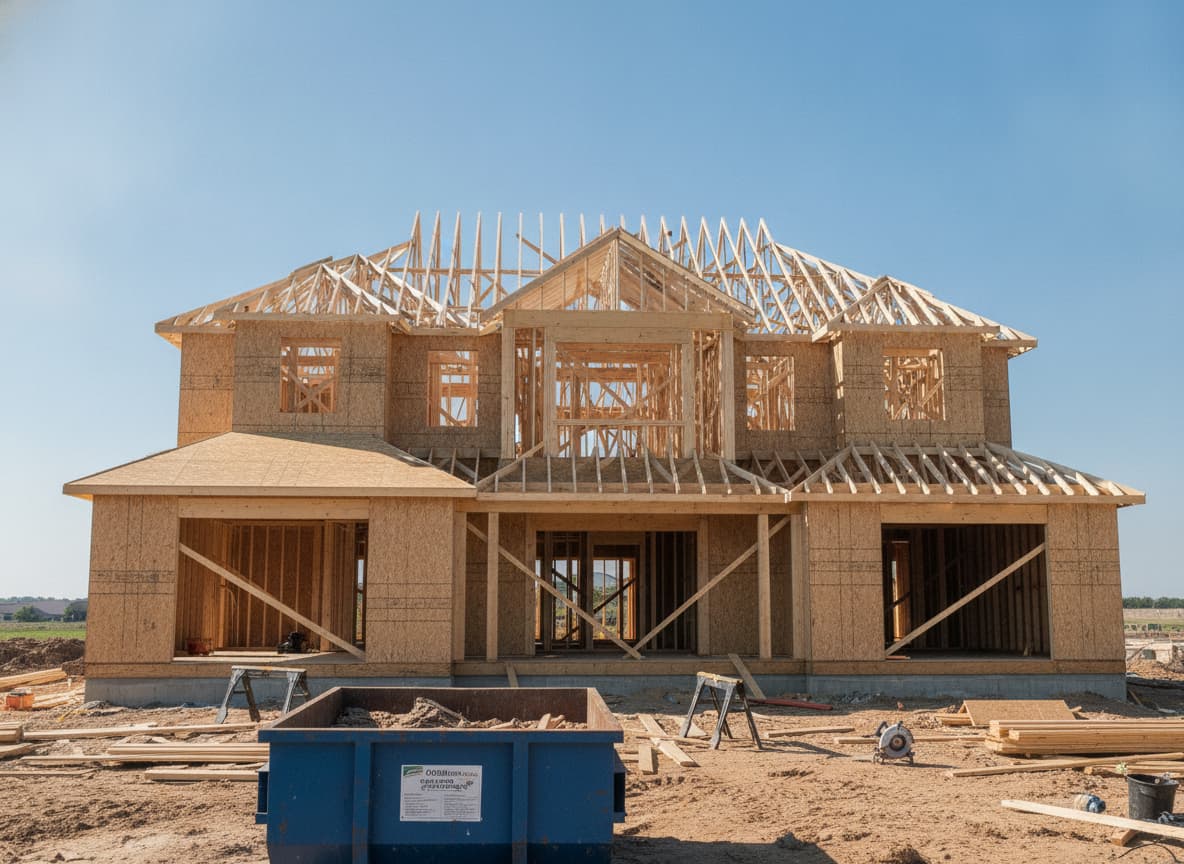
Understanding FHA construction loans
What is an FHA construction loan?
Think of an FHA construction loan as a helping hand from the federal government to build your dream home. Unlike traditional construction loans, which typically require perfect credit and huge down payments, FHA construction loans are designed to make homebuilding accessible to more Americans.
Here's what makes these loans special: the Federal Housing Administration (FHA)insures them, which means lenders are more willing to work with borrowers who might not qualify for conventional construction financing. It's like having a trusted friend vouch for you at the bank.
But here's the catch: while FHA loans are forgiving, they come with strict guidelines to protect both you and the lender. For example, your contractor must be a licensed, insured general contractor your lender approves, and your plans must meet specific safety and energy-efficiency standards.
Can you finance the land too? (FHA land and construction loans)
Here's the part that surprises most first-time builders: a one-time-close FHA construction loan can finance the land and the build togetherin a single loan with one closing. There's no separate lot loan to arrange first, and you don't have to already own the property — if you don't, the lot is purchased at the construction-loan closing. That's exactly what people mean when they search for an “FHA loan for land and construction.”
If you already own your lot, the equity in that land can count toward your 3.5% minimum investment — often reducing the cash you need at closing. The loan amount is based on the lesser of the finished home's appraised value or your total documented cost (land plus construction), and the combined amount has to fit within the FHA loan limit for your county. The lot itself must be residentially zoned, buildable, and served by utilities.
Types of FHA construction loans
There are two main flavors of FHA construction loans:
Construction-to-permanent loans. This is your one-stop-shop option. You get a single loan that covers both construction and your permanent mortgage. The best part? You only go through one closing process and one set of fees. During construction you typically only pay interest on the amount drawn, and once construction is complete it automatically converts to a permanent mortgage.
Ask your lender about “single-close” loans — these streamline the process even further by combining construction and permanent financing upfront.
203(k) rehabilitation loans.While not strictly for new construction, these loans help you purchase and renovate an existing home. They're worth mentioning because sometimes building from scratch isn't the best option for your situation.
- Limited 203(k): for minor repairs (up to $75,000)
- Standard 203(k): for major renovations (structural changes, room additions)
Energy-Efficient Mortgages (EEMs) — the hidden gem.This lesser-known FHA option lets you finance energy-efficient upgrades (solar panels, insulation, HVAC systems) into your loan. It's perfect if you want to build a green home without upfront costs.
Benefits and limitations
Benefits:
- Lower down payment requirements compared to conventional construction loans
- More flexible credit requirements
- Competitive interest rates thanks to government backing
- Single closing process for construction-to-permanent loans
- No income caps (unlike USDA loans)
Limitations:
- Must be your primary residence
- Requires mortgage insurance: upfront MIP of 1.75% of the loan amount, plus annual MIP of 0.15%–0.75% (varies by loan term, loan amount, and LTV; typically 0.55% for a 30-year loan with 3.5% down)
- Property must meet FHA standards (e.g., roof condition, foundation safety)
- Licensed contractors must perform the work — no DIY or self-help
Key requirements and qualifications
FICO score requirements
Let's talk credit scores — and don't worry, they're more forgiving than you might think. The minimum FICO score for an FHA construction loan is 580, though some lenders might require 620 or higher. If your score is between 500 and 579, you might still qualify with a larger down payment, like 10%.
If your credit score isn't quite where you need it, take a few months to: pay down credit card balances below 30% utilization, dispute errors on your credit report, and avoid new credit inquiries.
Down payment requirements
Here's where FHA construction loans really shine. While conventional construction loans often require 20–25% down, FHA construction loans require as little as 3.5%with a credit score of 580 or higher. If your score is between 500 and 579, you'll need 10% down.
But wait: your down payment can come from gift funds (e.g., family members) or grants! Just document the source thoroughly.
Property and construction requirements
The FHA has specific requirements for the property and construction process:
- The property must be your primary residence
- Construction must meet FHA minimum property standards (e.g., safe drinking water, functional HVAC)
- You need detailed construction plans and specifications (architectural drawings required)
- The lot must be zoned residential
- All work must comply with local building codes
Contractor requirements vs. DIY considerations
I often get asked, “Can I do the work myself?” The short answer is: generally no. FHA construction loans require a licensed, insured general contractor that your lender approves. This might seem limiting, but it's actually protecting your investment. Your contractor must:
- Be licensed and insured
- Have a proven track record
- Provide detailed cost estimates
- Be acceptable to your lender — and despite a common myth, there is no public “FHA-approved contractor” or “HUD contractor” list for these loans
The application process
Timeline expectations
The big question everyone asks: “How long does it take?” Here's a realistic timeline:
- Pre-approval: 1–2 weeks
- Contractor approval: 2–3 weeks
- Construction plans review: 2–4 weeks
- Final loan approval: 2–3 weeks
- Closing: 1–2 weeks
Total time from application to closing: typically 2–3 months.
A first-time buyer with a 600 credit score and 5% down chose FHA over conventional loans to avoid a 20% down payment. They closed in 11 weeks.
Required documentation
Be prepared to provide:
- Income verification: W-2s, tax returns (2 years), pay stubs (30 days)
- Bank statements and asset documentation (3 months)
- Construction plans and specifications (signed by architect)
- Contractor information and bids (include licenses and insurance certificates)
- Land documentation (deed, survey, zoning approvals)
Permit requirements
Yes, you need permits before closing — this is non-negotiable. Your contractor typically handles the permit process, but you should understand what's needed: building permits, zoning approvals, environmental assessments (if required), and utility permits.
If your contractor says, “We don't need permits for this,” run. Unpermitted work can void your loan and create legal headaches.
Construction plan approval
Your construction plans need to be detailed and FHA-compliant. This includes:
- Architectural drawings (floor plans, elevations)
- Material specifications (e.g., roofing type, insulation R-value)
- Cost breakdowns (labor vs. materials)
- Construction timeline (with milestones)
Alternative government-backed construction loans
| Feature | FHA Construction | VA Construction | USDA Construction |
|---|---|---|---|
| Minimum down payment | 3.5% | 0% | 0% |
| Credit score minimum | 580 | 620 (typically) | 640 (typically) |
| Property location | Anywhere | Anywhere | Rural areas only |
| Eligibility | Most buyers qualify | Veterans only | Income limits apply |
VA construction loans
For veterans, active service members, and eligible spouses, VA construction loans offer incredible benefits:
- No down payment required
- No private mortgage insurance
- Competitive interest rates
USDA construction loans
If you're looking to build in a rural area, USDA construction loans offer:
- 100% financing possible
- Lower mortgage insurance rates
- Income must be below the area median
Making your decision
Choosing between different loan types
Consider these factors when choosing your loan type:
- Down payment availability: can you afford 3.5%+?
- Credit score status: are you above 580?
- Military service history: are you eligible for VA benefits?
- Desired property location: is it rural? Check USDA eligibility.
- Income level: USDA has strict income caps.
Tips for success
- Start early: begin the process 6–12 months before breaking ground.
- Get pre-approved: know your budget before designing your home.
- Research contractors: get 3+ bids and check reviews on the BBB or Google.
- Build in contingencies: add a 10–15% buffer for unexpected costs (e.g., material shortages).
Common pitfalls to avoid
- Underestimating total costs: hidden fees like impact fees or soil testing can add thousands.
- Choosing an inexperienced contractor: verify they're properly licensed, insured, and acceptable to your lender.
- Rushing the planning phase: a poorly designed floor plan can't be fixed later.
- Not getting everything in writing: verbal promises won't hold up in disputes.
FHA construction loans in California: the Bay Area, North Bay & Central Valley
North Bay Capital is based in Santa Rosa and licensed across California, so we structure FHA construction-to-permanent loans wherever your lot sits in the state. We work with families building throughout the North Bay and Marin (Santa Rosa, Petaluma, Healdsburg, Windsor, Sonoma, and Novato), San Francisco and the Peninsula (including Burlingame and San Mateo County), the East Bay (Walnut Creek and the wider Contra Costa and Alameda area), and the Central Valley (Modesto in Stanislaus County and Hanford in Kings County) — as well as Southern California.
One California-specific thing to plan for is the loan limit. FHA sets limits county by county, and for 2026 the one-unit limit runs from a floor of $541,287 in lower-cost areas up to a high-cost ceiling of $1,249,125— San Francisco and the high-cost Bay Area counties reach that ceiling, while inland markets like the Central Valley sit nearer the floor, which often makes a ground-up build more attainable there. Because we're a local broker and not a national call center, we can match your build to the right program for your specific county and lot.
Ready to start your building journey?
Building your own home might seem daunting, but with an FHA construction loan it's more achievable than you might think. The key to success is preparation and working with experienced professionals who can guide you through the process. Next steps:
- Check your credit score and begin improving it if needed
- Save for your down payment
- Research and interview contractors
- Contact us to discuss your options