Home › Loan options › 1099 Income Loans
 Non-QM Lending for the Self-Employed
Get a mortgage using your 1099s, not your tax returns
If you earn 1099 income as an independent contractor, real estate agent, or commissioned salesperson, write-offs can shrink the income a traditional lender sees. A 1099 income loan qualifies you on your gross 1099 totals instead, so your real earning power counts.
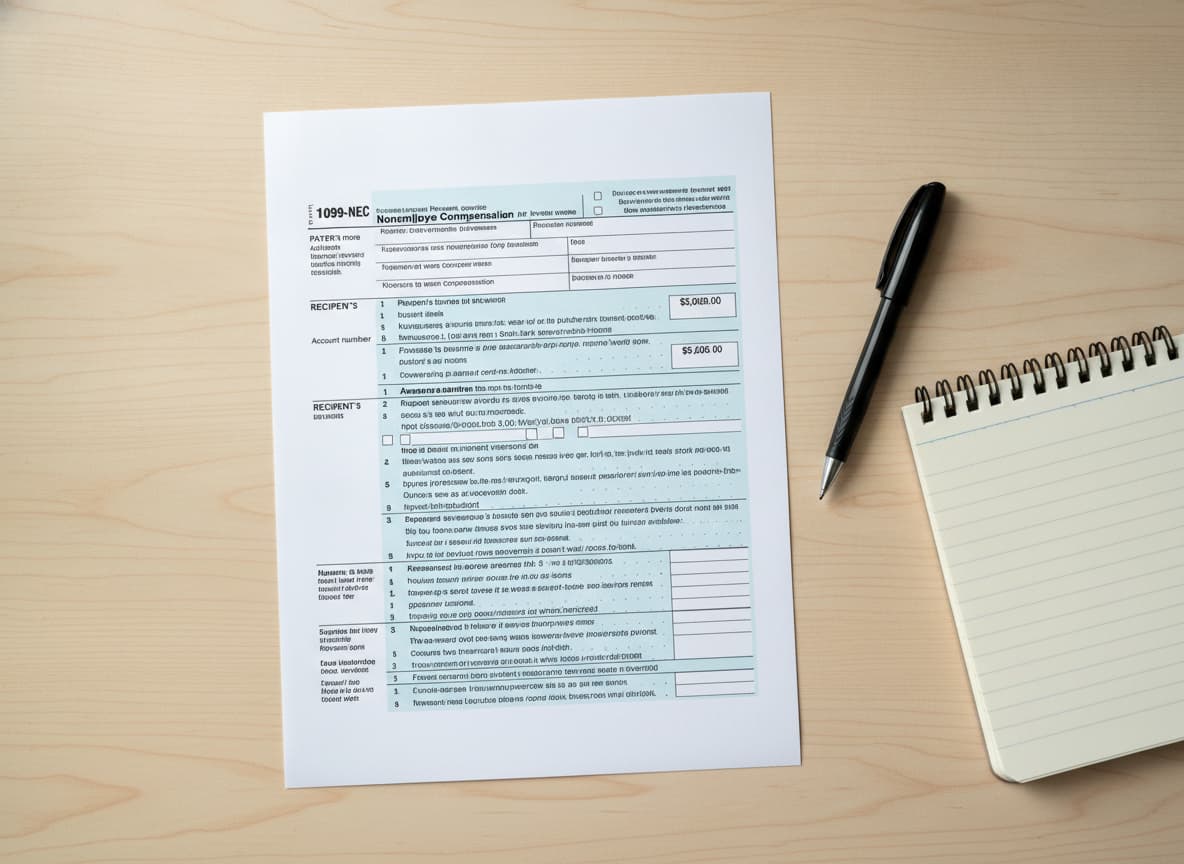
1099 income loans are non-QM mortgages that let independent contractors, gig workers, and commissioned earners qualify using one to two years of 1099 forms rather than full tax returns. Your income is calculated from gross 1099 receipts minus a modest expense factor, which often supports a larger loan than a tax-return-based approval.
Programs we broker
The options under 1099 income loans — and the right fit for each.
1-Year 1099 Income Loan
Qualify off a single year of 1099s — no tax returns required.
If you're an independent contractor, real estate agent, insurance producer, or any 1099 earner with one solid year of income, this is usually the cleanest path. We use the gross income reported on a single 1099 (or sometimes year-to-date earnings statements alongside it) instead of asking for two years of tax returns full of write-offs.
It's a Non-QM program, so the rate sits a touch above conventional, but for high-earning 1099 folks who deduct aggressively it almost always nets a bigger loan than a Fannie/Freddie file would. I'll show you both side by side before you commit.
- Real estate agents and loan officers with a strong recent year
- Independent contractors who just left a W-2 job
- Consultants and sales reps paid on 1099
2-Year 1099 Income Loan with Expense Factor
Two years of 1099s, simple expense factor — no Schedule C dissection.
This is the traditional Non-QM 1099 program. We average the gross income across the last two years of 1099s and apply a flat expense factor — typically 10% if you have light business overhead, more if your line of work runs heavier. No Schedule C, no P&L, no CPA letter required in most cases.
It's a strong fit when you've been self-employed long enough to have two clean years of 1099s but your tax returns make the numbers look smaller than they really are. We're documenting the income the IRS sees on the 1099 itself, not the after-write-off number on line 31.
- Established 1099 contractors with steady two-year history
- Borrowers whose tax returns understate true earning power
- Move-up purchases where conventional DTI won't stretch
1099 + Bank Statement Hybrid Loan
Blend 1099 income with personal or business bank statements for the strongest qualifying picture.
Some borrowers earn part of their income on 1099 and part as cash deposits, draws, or owner distributions that never hit a 1099. The hybrid program lets us document the 1099 piece directly and use 12 or 24 months of bank statements to capture the rest.
I use this most often for hairstylists and barbers with booth rent plus tips, contractors who get paid partly by check and partly by Zelle, and small-shop business owners who pay themselves through a mix of W-9 work and owner draws. The underwriter looks at the whole picture instead of forcing one income type to do all the work.
- Stylists, trainers, and trades with tips or cash on top of 1099 work
- Small-business owners with mixed pay structures
- Borrowers whose 1099 alone won't fully qualify them
1099 Loan for Investment Property (DSCR Alternative)
Use 1099 income to buy or refi a rental when DSCR doesn't pencil.
DSCR loans are great when the rent covers the payment, but in higher-priced California markets it often doesn't. If you're a 1099 earner buying a rental in Sonoma, Marin, or anywhere the numbers are tight, we can qualify you off your 1099 income instead of the property's rent.
Same documentation as the 1-year or 2-year 1099 program — we just structure it for non-owner occupancy. You keep the speed and simplicity of Non-QM without needing the rent to carry the deal.
- Bay Area rentals where DSCR ratios fall short
- 1099 earners building a small rental portfolio
- Cash-out refinances on investment property
1099 Cash-Out Refinance
Tap equity without surrendering your tax strategy.
Cash-out refis are where 1099 borrowers get hit hardest by conventional underwriting — every write-off you took shrinks the loan you qualify for. Using the 1-year or 2-year 1099 program for a cash-out keeps your tax planning intact and unlocks meaningfully more equity in most cases.
Common uses I see: paying off high-interest business debt, funding the next investment property, or consolidating a HELOC that's about to reset. We size the loan to your real cash flow, not your post-deduction Schedule C.
- Consolidating high-rate business or credit card debt
- Pulling equity to fund the next deal
- Replacing a resetting HELOC with a fixed rate
1099 Loan with Recent Self-Employment (Under 2 Years)
Newly independent? You don't have to wait two tax years to buy.
Conventional financing usually wants two full years of self-employment before it'll touch your income. The 1099 programs don't. If you transitioned from a W-2 role into 1099 work in the same line of business — say, an in-house designer who went freelance, or a staff nurse who moved to contract — we can often qualify you with as little as 12 months of 1099 history, sometimes less when paired with prior W-2s.
It's the program I reach for most when someone tells me 'my lender said come back next year.' In most cases, we don't have to wait.
- Recently independent professionals in the same line of work
- W-2-to-1099 transitions inside the last 1–2 years
- Borrowers told to 'come back next tax year' by another lender
Calculators for this loan
What people ask before they apply
What is a 1099 income loan?
A 1099 income loan is a non-qualified mortgage (non-QM) that lets you qualify using one to two years of 1099 forms instead of full federal tax returns. The lender totals your gross 1099 receipts and subtracts an expense factor to determine your qualifying income. It is built for independent contractors and commissioned earners whose tax write-offs make a conventional approval harder.
How is my income calculated on a 1099 loan?
The underwriter adds up the gross income on your 1099 forms over the documentation period, then applies an expense factor to account for business costs. On many programs that factor is roughly 10%, so about 90% of your gross 1099 income is counted. When 1099s are paid to an LLC rather than to you personally, lenders often apply a larger expense assumption, so the exact figure depends on the program and your file.
Do I need two years of 1099s, or will one year work?
Two years of 1099 history generally produces the strongest, best-priced file. Some programs accept a single year of 1099s, especially when you have compensating factors such as solid reserves, a larger down payment, or a strong credit score. Because North Bay Capital is a brokerage, we can match a one-year scenario to a lender that allows it rather than forcing your file into one box.
What credit score and down payment do I need for a 1099 loan?
These are non-QM programs, so requirements vary by lender. Many start around a 680 credit score, with the best pricing reserved for borrowers at 700 to 740 and above. Down payments commonly range from about 10% to 20% depending on your credit, occupancy, and the strength of the file. Higher credit and larger down payments typically unlock better terms.
Can I use a 1099 loan to buy a primary home, or only an investment property?
You can use 1099 income loans for primary residences, second homes, and investment properties. The occupancy type affects pricing, down payment, and reserve requirements, but the 1099 qualification method itself applies across all three. We will confirm the specifics for your scenario before you commit.
How is a 1099 loan different from a bank-statement or P&L loan?
All three are non-QM paths for self-employed borrowers, but they read different documents. A 1099 loan uses your 1099 forms and a fixed expense factor. A bank-statement loan calculates income from 12 to 24 months of deposits, which can help when your deposits exceed your 1099 totals. A profit-and-loss (P&L) loan relies on a CPA-prepared statement of your business income. We compare all three and recommend whichever produces the strongest, most accurate qualification for you.
I write off a lot on my taxes. Will a 1099 loan still help me?
Yes, that is exactly the situation these loans are built for. Because qualifying income comes from your gross 1099 totals minus a set expense factor rather than from your net taxable income, aggressive but legitimate tax write-offs do not directly reduce the income that qualifies you. Many contractors qualify for a meaningfully larger loan this way than a tax-return-based program would allow.
Are 1099 loan rates higher than conventional mortgage rates?
Non-QM programs, including 1099 income loans, usually price somewhat higher than conventional Fannie Mae or Freddie Mac loans because they carry more flexible documentation. The exact difference depends on your credit, down payment, occupancy, and the lender. As a broker, North Bay Capital shops multiple non-QM lenders to find the most competitive terms for your file, and many borrowers later refinance into a conventional loan once their tax returns support it.
Jesse Gonzalez, President & Founder
NMLS #278103 · CA DRE #01855372 · Last reviewed June 24, 2026
Let's see what your 1099s really qualify you for
If your tax returns don't reflect what you actually earn, a 1099 income loan may be the cleaner path. Call Jesse Gonzalez at North Bay Capital at 707-595-5393, or email jesse@northbaycap.com, for a straight answer on whether this program fits your situation. As a brokerage, we shop multiple non-QM lenders so the program matches you, not the other way around.