Home › Commercial › Multifamily Loans
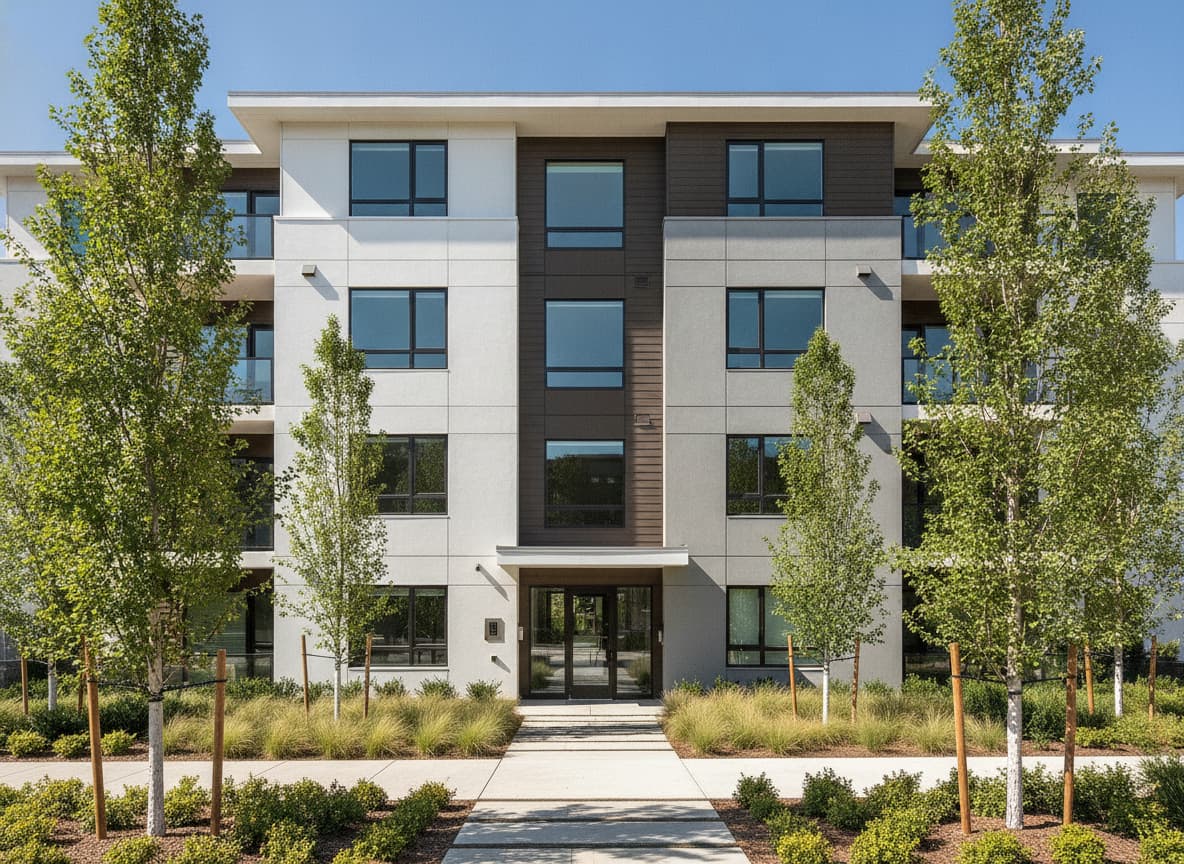 Commercial Real Estate Financing
Apartment loans built around the property's income, not just your credit
Once a building hits five units it becomes commercial real estate, and the loan is sized on what the property earns. North Bay Capital shops agency, bank, bridge, and construction lenders to find the structure that fits your deal.
Buildings with five or more units are financed as commercial multifamily, and loans are sized mainly on the property's net operating income through a debt-service coverage test rather than your personal income alone. North Bay Capital is a brokerage that compares Fannie Mae and Freddie Mac agency programs, bank and portfolio loans, bridge financing, and construction-to-perm options so investors get the right fit for a purchase, refinance, cash-out, value-add, or ground-up project.
Programs we broker
The options under multifamily loans — and the right fit for each.
Fannie Mae Small Balance Loan (SBL)
Agency execution for 5+ unit apartment buildings from about $1M to $9M.
Fannie's SBL is built for the bread-and-butter end of the apartment market — stabilized properties with at least five units that don't need a custom credit memo. You get non-recourse debt (with standard carve-outs), 30-year amortization, and fixed-rate options in the 5, 7, 10, and sometimes 12-year terms. I quote it most often against bank money because the rate stays competitive and the prepay is flexible (declining, yield maintenance, or graduated).
It works best on properties in markets Fannie classifies as Top, Standard, Small, or Very Small — Sonoma, Marin, Napa, Alameda, and most of the Bay Area all fit. Plan on roughly 1.25x DSCR minimum (1.20x in stronger MSAs) and up to 80% LTV on purchase, 75% on cash-out. Sponsor net worth and liquidity tests are real but reasonable.
- Acquiring a stabilized Bay Area apartment building
- Refinancing out of a bank loan onto long-term fixed debt
- Locking 10-year money before a rate move
Freddie Mac Small Balance Loan (SBL)
Freddie's small-balance program — fast, streamlined, and often the lowest-rate option.
Freddie's SBL program competes head-to-head with Fannie's and I shop them both on every deal because the winner moves around based on market tier, leverage, and prepay choice. Loan sizes run roughly $1M to $7.5M (sometimes higher in top markets), with hybrid ARMs (20-year fixed-after-reset structure) and straight fixed-rate options out to 10 years.
Freddie tends to like clean, stabilized deals with strong T-12 financials. The underwriting is more standardized than agency standard, which is what makes it quick — typical close is 45 to 60 days. Non-recourse, 30-year amortization, and the prepay menu includes a soft step-down on hybrid ARMs that some borrowers prefer over yield maintenance.
- Quick close on a stabilized 10–60 unit building
- Hybrid ARM borrower who wants step-down prepay
- Cash-out refi to pull equity for the next acquisition
Fannie Mae & Freddie Mac Agency Standard ($7.5M+)
Custom-underwritten agency execution for mid-to-large apartment deals.
Once a deal gets above the small-balance ceiling — generally $7.5M and up — it moves to agency standard underwriting. That means a full credit memo, more flexibility on structure (supplemental loans, interest-only periods, green/affordable rate breaks), and access to terms out to 15 years fixed. Both Fannie's DUS program and Freddie's Optigon work here, and I'll run the deal through both shops to find the best execution.
Agency standard is where the real pricing advantage shows up: interest-only periods of 1 to 10 years (sometimes full-term IO at lower leverage), green building rate reductions if the property qualifies, and the ability to layer a supplemental loan two or three years in if NOI grows. Non-recourse, 30-year amortization, and you can comfortably go to 75–80% LTV on purchases.
- Acquiring a mid-size apartment portfolio
- Refi with cash-out and a long IO runway
- Green retrofit pricing on a workforce-housing asset
Bank & Portfolio Multifamily Loans
Recourse balance-sheet debt — flexible underwriting for properties agency won't touch.
Not every apartment building fits an agency box. Older Sonoma County fourplexes that got reclassified as 5+ after a conversion, mixed-use properties where the commercial component is too large, deals with deferred maintenance, or sponsors who need a faster close — those go to portfolio lenders. I keep relationships with regional banks and credit unions across California that hold these loans on their own books.
Expect recourse or partial-recourse structures, 5/5 or 7/1 ARM terms with 25–30 year amortization, and rates that float around (and often a bit above) agency. The trade is flexibility: shorter timelines, common-sense underwriting on the rent roll, and a real human you can call when something on the deal needs to flex.
- Mixed-use building with too much commercial sf for agency
- Property with deferred maintenance the seller won't fix
- Sponsor wants a relationship lender, not a servicer
Multifamily Bridge Loans (Value-Add & Repositioning)
Short-term debt to buy, renovate, lease up, then refinance into perm.
Bridge debt is the right tool when the building isn't ready for agency yet — vacant units to renovate, rents 20% below market, or a recent acquisition you need to season before a Fannie or Freddie refi will pencil. I work with debt funds, specialty lenders, and a couple of bank programs that do bridge with a built-in path to perm.
Terms typically run 12 to 36 months, interest-only, with extension options. Pricing is higher than perm (think SOFR plus a spread), but the leverage is higher too — up to 75–80% of cost including the renovation budget. The whole point is to execute the business plan, prove the NOI lift, then refinance into a 10-year fixed agency loan and pull most of your equity back.
- Buying a tired 30-unit and renovating to push rents
- Lease-up loan on a recently completed building
- Recapitalizing a partnership before perm refi
HUD 221(d)(4) Construction-to-Permanent
40-year fixed, non-recourse ground-up construction financing — the cheapest long money in the market.
HUD 221(d)(4) is the gold standard for building new market-rate or affordable apartments. It funds construction and converts to a fully-amortizing 40-year permanent loan, all at one fixed rate locked at closing. Non-recourse, assumable, and the rate is genuinely lower than anything else available for new construction at this duration.
The trade-off is timing — expect 9 to 12 months to close, sometimes longer, because of HUD's third-party reports, Davis-Bacon wage requirements, and the firm commitment process. Sponsors need real multifamily development experience and the equity stack has to work at 85% loan-to-cost. For the right project, nothing beats it; for a sponsor who needs to close in 90 days, it's the wrong tool.
- Ground-up market-rate apartment development
- LIHTC affordable housing construction
- Substantial rehab of an existing 5+ unit property
Multifamily Refinance & Cash-Out
Replace a maturing bank loan, lock long-term debt, or pull equity for the next deal.
Most apartment owners refinance for one of three reasons: a balloon is coming due, rates have moved and the current loan is stale, or NOI has grown enough that there's real equity to pull out. I shop refi requests across agency (Fannie/Freddie SBL or standard), bank/portfolio, and CMBS depending on size, market, and how much cash-out you want.
On a cash-out refi, agency will go to about 75% LTV with a 1.25x DSCR; bank programs usually cap at 70%. There's no seasoning requirement on most agency programs anymore — if you bought it 13 months ago and rents are up, we can pull cash. I run the numbers both ways (rate-and-term vs. cash-out) so you can see what each costs and what each frees up for the next acquisition.
- Bank loan ballooning — moving to 10-yr fixed agency
- Cash-out to fund the down payment on the next building
- Rate-and-term refi to drop the payment and improve cash flow
Calculators for this loan
What people ask before they apply
When does an apartment building count as commercial rather than residential?
The line is five units. A property with one to four units is treated as residential and can use conventional or government residential mortgages. Once a building has five or more units it is classified as commercial multifamily, which changes how it is underwritten: the loan is sized largely on the property's income through a debt-service coverage test, and down payment and reserve requirements are generally higher.
How is a multifamily loan sized? What is DSCR?
Debt-service coverage ratio, or DSCR, is the property's net operating income divided by its annual loan payment. A 1.25x DSCR means the building earns 25 percent more than it needs to cover the debt. Most agency apartment loans want a minimum around 1.25x, though stronger markets can allow a bit less and smaller markets may require more. The lender uses DSCR and loan-to-value together to set the maximum loan, so a low-cash-flow building may be capped below the LTV limit.
What down payment do I need for a 5+ unit apartment loan?
Plan for roughly 20 to 30 percent down on most commercial multifamily purchases, which corresponds to loan-to-value limits of about 70 to 80 percent. Agency programs reach the higher end of leverage for stabilized properties, while bank and portfolio lenders often want a larger cushion. The property's cash flow can be the real constraint, since a building has to clear the DSCR test at the requested loan amount.
Are agency multifamily loans non-recourse?
Generally yes. Fannie Mae and Freddie Mac apartment loans are typically non-recourse, meaning you are not personally liable for the debt beyond standard carve-outs for bad acts like fraud, misrepresentation, or unauthorized transfers. Bank and portfolio loans, by contrast, are frequently recourse and require a personal guaranty, which is one of the trade-offs to weigh when comparing your options.
Can I do a cash-out refinance on my apartment building?
Yes. Cash-out refinancing is common for buy-and-hold investors who have built equity through appreciation or rent growth and want to redeploy it into the next purchase or improvements. The amount you can pull is governed by the same DSCR and LTV limits as a purchase, so the building's current income and value drive how much cash is available. We will run the numbers on your specific property before you count on a figure.
How do I finance a value-add apartment deal that is not stabilized yet?
Properties with vacancy, deferred maintenance, or below-market rents usually do not qualify for agency or standard bank loans, which want stabilized income. The common path is a short-term bridge loan to acquire and renovate, sized partly on the projected stabilized value, followed by a permanent refinance once the income is fixed. The key is planning the exit up front so the bridge has a clear takeout.
What loan terms and amortization are available on apartment loans?
Agency programs commonly offer fixed periods of 5, 7, or 10 years with amortization stretched up to 30 years, and interest-only options on some deals. Bank and portfolio loans often run a 5 to 10 year fixed period with a balloon or rate reset. Construction-to-perm loans are interest-only during the build and then convert to a longer permanent term. The right combination depends on how long you plan to hold and your view on rates.
Does North Bay Capital lend nationwide on multifamily?
North Bay Capital is a brokerage, so we shop many lenders rather than fund from a single product. Our residential lending is focused on Sonoma County, the North Bay, and California, while our commercial lending, including multifamily, is offered broadly. Jesse Gonzalez is licensed in California, Colorado, Florida, and Alabama, and for commercial deals we work with a national network of agency, bank, bridge, and construction lenders.
Jesse Gonzalez, President & Founder
NMLS #278103 · CA DRE #01855372 · Last reviewed June 24, 2026
Talk through your apartment deal with a real person
Whether you are buying your first five-unit building, refinancing out of a maturing bank loan, or planning a ground-up project, the right structure depends on the numbers. Call Jesse Gonzalez at North Bay Capital at 707-595-5393, or email jesse@northbaycap.com, and we will tell you honestly which lenders fit your deal.